Summary:
This is Lecture 10 for the topic “Work, Energy and Power”. You can find all resources related with Work, Energy and Power by clicking on this link. Here we will cover the concept of Elastic collision in One Dimension and different aspects of it.
1. Introduction to Collisions & Classification
A collision is a short-duration interaction between two or more bodies resulting in internal impulsive forces acting between them. Regardless of the type of collision, total linear momentum is always conserved because external impulsive forces during a collision are negligible compared to the mutual interaction forces.
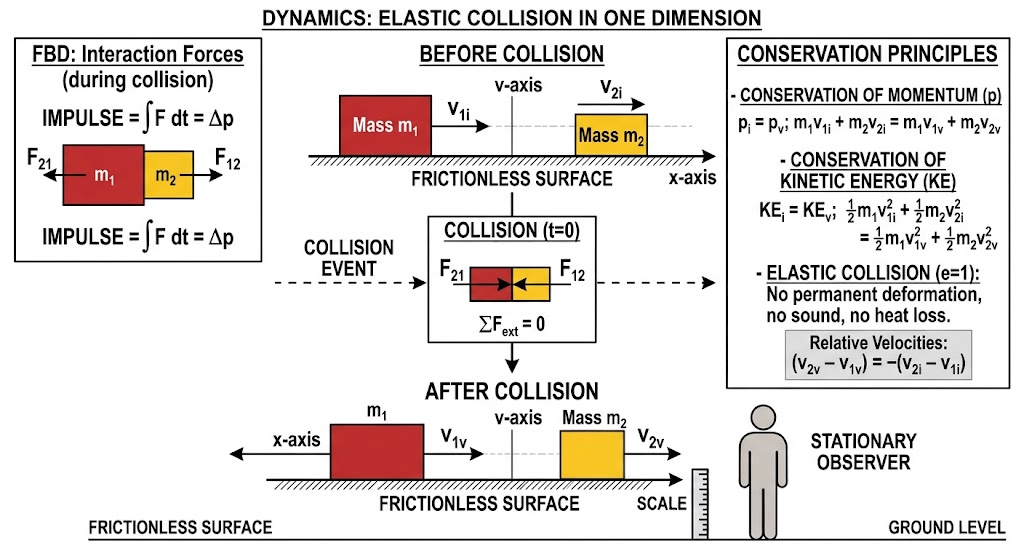
Collisions are classified based on the conservation of Total Mechanical Energy (specifically Kinetic Energy):
- Perfectly Elastic Collision: Both linear momentum and kinetic energy are conserved. There is no permanent deformation or loss of energy into heat, sound, or light. (Coefficient of restitution $e = 1$).
- Inelastic Collision: Linear momentum is conserved, but kinetic energy is not conserved. Some energy is dissipated into heat, sound, or deformation. ($0 < e < 1$).
- Perfectly Inelastic Collision: A special case of inelastic collision where the colliding bodies stick together after impact and move with a common velocity. ($e = 0$, maximum loss of kinetic energy).
2. The Two Core Conservation Laws (For 1D Elastic Collision)
Consider two bodies of masses $m_1$ and $m_2$ moving along a straight line (1D) with initial velocities $u_1$ and $u_2$ (where $u_1 > u_2$ to ensure they collide). After an elastic collision, let their final velocities be $v_1$ and $v_2$.
Law 1: Conservation of Linear Momentum
$$m_1 u_1 + m_2 u_2 = m_1 v_1 + m_2 v_2$$
Rearranging terms:
$$m_1 (u_1 – v_1) = m_2 (v_2 – u_2) \quad \text{— (Equation 1)}$$
Law 2: Conservation of Kinetic Energy
$$\frac{1}{2}m_1 u_1^2 + \frac{1}{2}m_2 u_2^2 = \frac{1}{2}m_1 v_1^2 + \frac{1}{2}m_2 v_2^2$$
Canceling $\frac{1}{2}$ and rearranging:
$$m_1 (u_1^2 – v_1^2) = m_2 (v_2^2 – u_2^2) \quad \text{— (Equation 2)}$$
3. The Coefficient of Restitution ($e$)
Dividing Equation 2 by Equation 1:
$$(u_1 + v_1) = (v_2 + u_2)$$
$$u_1 – u_2 = v_2 – v_1$$
This yields the fundamental law of relative velocities:
$$\text{Relative Velocity of Separation} = \text{Relative Velocity of Approach}$$
$$v_2 – v_1 = u_1 – u_2$$
We define the Coefficient of Restitution ($e$) as:
$$e = \frac{\text{Relative velocity of separation along line of impact}}{\text{Relative velocity of approach along line of impact}} = \frac{v_2 – v_1}{u_1 – u_2}$$
- For a perfectly elastic collision, $e = 1$.
- For a perfectly inelastic collision, $e = 0$.
4. Derivation of Final Velocities ($v_1$ and $v_2$)
By solving the simultaneous equations of momentum conservation and $v_2 – v_1 = u_1 – u_2$ (for $e=1$), we obtain the standard formula for final velocities in a 1D elastic collision:
$$v_1 = \frac{(m_1 – m_2)u_1 + 2m_2 u_2}{m_1 + m_2}$$
$$v_2 = \frac{(m_2 – m_1)u_2 + 2m_1 u_1}{m_1 + m_2}$$
5. High-Yield Special Cases for JEE-Mains
Case A: Equal Masses ($m_1 = m_2 = m$)
Substituting $m_1 = m_2$ into the velocity formulas:
- $v_1 = u_2$
- $v_2 = u_1$
Takeaway: When two bodies of equal mass undergo a 1D elastic collision, they exchange their velocities. If the second body was initially at rest ($u_2 = 0$), the first body stops completely ($v_1 = 0$), and the second body moves off with the initial velocity of the first ($v_2 = u_1$).
Case B: Massive Body Collides with a Stationary Light Body ($m_1 \gg m_2$, $u_2 = 0$)
- $v_1 \approx u_1$ (The massive body continues moving with almost no change in velocity).
- $v_2 \approx 2u_1$ (The light body is thrown forward at twice the velocity of the heavy body).
Case C: Light Body Collides with a Massive Stationary Body ($m_1 \ll m_2$, $u_2 = 0$)
- $v_1 \approx -u_1$ (The light body rebounds with almost the exact same speed in the opposite direction).
- $v_2 \approx 0$ (The massive body remains practically at rest).
6. Kinetic Energy Transfer in 1D Elastic Collision
The fraction of kinetic energy transferred from the moving body ($m_1$) to the stationary target body ($m_2$) is given by:
$$\frac{\Delta K}{K_1} = \frac{4m_1 m_2}{(m_1 + m_2)^2}$$
- Maximum Energy Transfer ($100\%$) occurs when $m_1 = m_2$. This is why nuclear reactors use moderators like heavy water (deuterium) or graphite blocks (masses comparable to neutrons) to slow down fast neutrons efficiently via elastic collisions.
JEE-Mains/NEET Practice Questions
Question 1: Standard Velocity Calculation
A sphere of mass $2 \text{ kg}$ moving with a velocity of $5 \text{ m/s}$ undergoes a head-on elastic collision with another stationary sphere of mass $3 \text{ kg}$. Find the velocity of the second sphere after the collision.
(a) $2 \text{ m/s}$
(b) $4 \text{ m/s}$
(c) $6 \text{ m/s}$
(d) $2.5 \text{ m/s}$
Solution:
Given: $m_1 = 2 \text{ kg}$, $u_1 = 5 \text{ m/s}$, $m_2 = 3 \text{ kg}$, $u_2 = 0$.
Using the formula for final velocity $v_2$:
$v_2 = \frac{(m_2 – m_1)u_2 + 2m_1 u_1}{m_1 + m_2}$
$v_2 = \frac{(3 – 2)(0) + 2(2)(5)}{2 + 3}$
$v_2 = \frac{0 + 20}{5} = 4 \text{ m/s}$.
Answer: (b)
Question 2: Exchange of Velocities
Two identical particles A and B, each of mass $m$, are moving along the same straight line towards each other with speeds $u$ and $2u$ respectively. If the collision is perfectly elastic, what are their velocities after the collision?
(a) $-2u$ and $u$
(b) $2u$ and $-u$
(c) $-u$ and $-2u$
(d) $u$ and $2u$
Solution:
Let the direction of particle A be positive ($\rightarrow$) and particle B be negative ($\leftarrow$).
Initial velocities: $u_1 = +u$ and $u_2 = -2u$.
Since the masses are identical ($m_1 = m_2 = m$), the particles exchange their velocities in a 1D elastic collision:
$v_1 = u_2 = -2u$
$v_2 = u_1 = +u$
Answer: (a)
Question 3: Maximum Energy Transfer
A neutron of mass $m$ makes a head-on elastic collision with a stationary nucleus. Under what condition will the neutron transfer the maximum fraction of its kinetic energy to the nucleus?
(a) Mass of the nucleus is much greater than $m$
(b) Mass of the nucleus is much smaller than $m$
(c) Mass of the nucleus is equal to $m$
(d) Energy transfer is independent of mass
Solution:
The fraction of kinetic energy transferred is given by $\frac{\Delta K}{K_1} = \frac{4m_1 m_2}{(m_1 + m_2)^2}$.
To maximize this expression with respect to $m_2$, the denominator must be minimized relative to the numerator, which occurs when $m_1 = m_2$ (i.e., when the target mass equals the neutron mass).
Answer: (c)
Question 4: Rebound and Velocity Ratio
A ball of mass $m$ moving with speed $v$ makes a head-on elastic collision with a stationary ball of mass $M$. If the incident ball rebounds with one-third of its initial speed, the ratio of masses $\frac{M}{m}$ is:
(a) $1$
(b) $2$
(c) $3$
(d) $4$
Solution:
- Initial velocity of mass $m$ is $u_1 = v$, and mass $M$ is $u_2 = 0$.
- After collision, mass $m$ rebounds with speed $\frac{v}{3}$, so $v_1 = -\frac{v}{3}$ (taking opposite direction).
- Using the law of restitution for elastic collision ($e = 1$):
$v_2 – v_1 = u_1 – u_2 \implies v_2 – \left(-\frac{v}{3}\right) = v – 0$
$v_2 + \frac{v}{3} = v \implies v_2 = \frac{2v}{3}$. - Use momentum conservation:
$m(v) + M(0) = m\left(-\frac{v}{3}\right) + M\left(\frac{2v}{3}\right)$
$v = -\frac{mv}{3} + \frac{2Mv}{3}$
Divide by $v$ and rearrange:
$1 = -\frac{m}{3} + \frac{2M}{3} \implies 3 = -m + 2M \implies 2M = 4m \implies \frac{M}{m} = 2$.
Answer: (b)