Blog

  • L2: Work Done by a Variable Force

    Summary:

    This is lecture 2 for the topic Work, Energy and Power. You can find notes of lecture 1 for this topic here.

    1. Why $W = \vec{F} \cdot \vec{s}$ Fails

    The formula $W = \vec{F} \cdot \vec{s}$ only applies when the force is strictly constant in both magnitude and direction over the entire displacement. However, in the real world (and in JEE problems), forces frequently change as an object moves:

    • Springs: The force increases as you stretch it ($F = -kx$).
    • Gravity (Large distances): The force weakens as you move away from a planet ($F = \frac{GMm}{r^2}$).
    • Time/Position-dependent fields: Electric or magnetic fields that vary across space.

    If the force varies, we cannot use a single value for $\vec{F}$. We must break the displacement into infinitesimally small steps where the force can be considered constant.

    2. The Integration Method (Calculus Approach)

    Assume a particle undergoes an infinitesimally small displacement $d\vec{r}$. Over this tiny distance, a variable force $\vec{F}$ is effectively constant.

    The infinitesimally small work done $dW$ is:

    $$dW = \vec{F} \cdot d\vec{r}$$

    To find the total work done from an initial position $\vec{r}_i$ to a final position $\vec{r}_f$, we sum up all these tiny contributions using integration:

    $$W = \int_{\vec{r}_i}^{\vec{r}_f} \vec{F} \cdot d\vec{r}$$

    Cartesian (3D) Form:

    In JEE problems, $\vec{F}$ is often given as a function of coordinates: $\vec{F} = F_x \hat{i} + F_y \hat{j} + F_z \hat{k}$.

    The infinitesimal displacement is $d\vec{r} = dx \hat{i} + dy \hat{j} + dz \hat{k}$.

    The dot product expands the integral into three separate 1D integrals:

    $$W = \int_{x_i}^{x_f} F_x dx + \int_{y_i}^{y_f} F_y dy + \int_{z_i}^{z_f} F_z dz$$

    (Note: For conservative forces, this integration is path-independent. For non-conservative forces like friction, it depends on the specific path taken.)

    3. The Graphical Method (Area Under the Curve)

    Geometrically, the definite integral $\int F dx$ represents the area bounded by the Force vs. Position curve and the position axis.
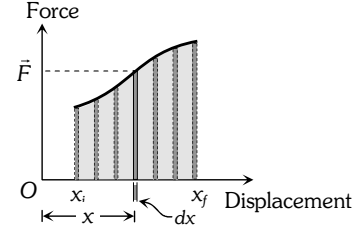
    Key Rules for Graphical Problems:

    1. Work = Area under the $F-x$ graph.
    2. Sign Convention:
    • Area above the x-axis ($F > 0$) represents positive work (force and displacement are in the same direction; kinetic energy increases).
    • Area below the x-axis ($F < 0$) represents negative work (force opposes displacement; kinetic energy decreases).
    1. Total Work: $W_{total} = (\text{Area above axis}) – (\text{Area below axis})$.

    4. Classic Application: Work Done by a Spring

    A perfectly elastic spring obeys Hooke’s Law: $F_s = -kx$.

    If we stretch a spring from its natural length ($x_i = 0$) to a position $x_f = x$, the work done by the spring force is:

    $$W_s = \int_{0}^{x} (-kx) dx = -k \left[ \frac{x^2}{2} \right]_0^x = -\frac{1}{2}kx^2$$

    The negative sign indicates the spring force always opposes the displacement (stretching or compressing).

    Conversely, the work done by the external applied force (which must be $+kx$ to stretch it slowly) is:

    $$W_{ext} = \int_{0}^{x} (kx) dx = +\frac{1}{2}kx^2$$

    JEE-Mains Practice Questions

    Question 1: 1D Integration

    A particle of mass $2 \text{ kg}$ is subjected to a one-dimensional variable force $F(x) = (3x^2 – 2x + 1) \text{ N}$. Calculate the work done by this force in moving the particle from $x = 1 \text{ m}$ to $x = 3 \text{ m}$.

    Solution:

    $W = \int_{x_i}^{x_f} F(x) dx$

    $W = \int_{1}^{3} (3x^2 – 2x + 1) dx$

    $W = \left[ x^3 – x^2 + x \right]_1^3$

    Substitute upper limit: $(3^3 – 3^2 + 3) = 27 – 9 + 3 = 21$

    Substitute lower limit: $(1^3 – 1^2 + 1) = 1 – 1 + 1 = 1$

    $W = 21 – 1 = 20 \text{ J}$

    Question 2: 2D Force Field

    A force $\vec{F} = (y\hat{i} + x\hat{j}) \text{ N}$ acts on a particle. Find the work done by this force in moving the particle from the origin $(0,0)$ to the point $(2 \text{ m}, 2 \text{ m})$ along the straight line path $y = x$.

    Solution:

    Since the path is $y = x$, it follows that $dy = dx$.

    We can substitute $y$ with $x$ in our integral to make it a single variable integration.

    $W = \int (F_x dx + F_y dy)$

    $W = \int (y dx + x dy)$

    Substitute $y=x$ and $dy=dx$:

    $W = \int_{0}^{2} (x dx + x dx) = \int_{0}^{2} 2x dx$

    $W = \left[ x^2 \right]_0^2 = 2^2 – 0^2 = 4 \text{ J}$

    (Note: This force is conservative, $\vec{F} = \nabla(xy)$, so $W$ is just $\Delta(xy) = (2)(2) – (0)(0) = 4 \text{ J}$. Teaching both methods is highly recommended!)

    Question 3: Graphical Method

    The force acting on a particle varies with position $x$ as shown in a graph. The graph consists of a straight line from $(0\text{ m}, 10\text{ N})$ to $(4\text{ m}, 10\text{ N})$, followed by a straight line dropping to $(8\text{ m}, 0\text{ N})$, and then continuing to $(10\text{ m}, -5\text{ N})$. What is the total work done from $x = 0$ to $x = 10 \text{ m}$?

    Solution:

    We calculate the area of three geometric shapes:

    1. Rectangle from $x=0$ to $4$: Area $= 4 \times 10 = 40 \text{ J}$
    2. Triangle from $x=4$ to $8$: Area $= \frac{1}{2} \times (8-4) \times 10 = \frac{1}{2} \times 4 \times 10 = 20 \text{ J}$
    3. Triangle from $x=8$ to $10$ (below axis): Area $= \frac{1}{2} \times (10-8) \times (-5) = \frac{1}{2} \times 2 \times (-5) = -5 \text{ J}$

    $W_{total} = 40 + 20 + (-5) = 55 \text{ J}$

  • L1: Work Done by a Constant Force

    1. The Physics Definition of Work

    In everyday language, “work” implies physical or mental effort. In physics, work has a highly specific, mathematically rigorous definition: Work is done when a force causes a displacement, and there is a component of the force in the direction of the displacement.

    If a constant force $F$ acts on an object while it undergoes a straight-line displacement $s$, the work $W$ done by the force is:

    $$W = Fs \cos \theta$$

    Where:

    • $F$ is the magnitude of the constant force (in Newtons, N).
    • $s$ is the magnitude of the displacement (in meters, m).
    • $\theta$ is the angle between the force vector and the displacement vector.
    • The SI unit of work is the Joule (J), where $1 \text{ J} = 1 \text{ N} \cdot \text{m}$.

    2. Work as a Vector Dot Product

    For JEE-Mains, students must be extremely comfortable moving away from the scalar formula and into vector algebra. The formula $W = Fs \cos \theta$ is the geometric definition of the dot product (or scalar product) of two vectors.

    Therefore, work is the dot product of the force vector $\vec{F}$ and the displacement vector $\vec{s}$:

    $$W = \vec{F} \cdot \vec{s}$$

    The Geometric Interpretation (Projection):

    The dot product can be grouped in two conceptual ways, both mathematically identical but physically distinct:

    1. $W = (F \cos \theta)s$: The product of the displacement and the component of the force parallel to the displacement.
    2. $W = F(s \cos \theta)$: The product of the force and the component of the displacement parallel to the force.

    3. The Three Regimes of Work

    The angle $\theta$ entirely dictates the sign of the work done, representing whether energy is being added to or removed from the system.

    Angle (θ)Value of cosθWork SignPhysical MeaningExample
    $0^\circ \le \theta < 90^\circ$PositivePositive ($W > 0$)Force adds kinetic energy to the system.Pushing a block forward.
    $\theta = 90^\circ$ZeroZero ($W = 0$)Force does not affect the speed of the object.Tension in a pendulum string; Centripetal force.
    $90^\circ < \theta \le 180^\circ$NegativeNegative ($W < 0$)Force removes kinetic energy (slows the object down).Kinetic friction; Air resistance.

    4. Cartesian (3D) Coordinate Form

    In JEE problems, forces and displacements are frequently given in unit vector notation.

    If $\vec{F} = F_x \hat{i} + F_y \hat{j} + F_z \hat{k}$ and

    the displacement is

    $\vec{s} = \Delta x \hat{i} + \Delta y \hat{j} + \Delta z \hat{k}$,

    the dot product expands algebraically. Because the dot product of perpendicular unit vectors is zero ($\hat{i} \cdot \hat{j} = 0$) and parallel unit vectors is one ($\hat{i} \cdot \hat{i} = 1$), the calculation simplifies to:

    $$W = F_x \Delta x + F_y \Delta y + F_z \Delta z$$

    Finding Displacement from Coordinates:

    If a particle moves from an initial point $A(x_1, y_1, z_1)$ to a final point $B(x_2, y_2, z_2)$, the displacement vector is the difference between their position vectors:

    $$\vec{s} = \vec{r}_B – \vec{r}_A = (x_2 – x_1)\hat{i} + (y_2 – y_1)\hat{j} + (z_2 – z_1)\hat{k}$$

    5. Superposition (Multiple Forces)

    Work is a scalar quantity. If multiple forces act on a body simultaneously, the net work done can be calculated in two ways:

    1. Scalar Addition: Calculate the work done by each force individually, then sum them up:
      $W_{net} = W_1 + W_2 + \dots$
    2. Vector Addition: Find the net force vector first, then take the dot product with the displacement:
      $W_{net} = \vec{F}_{net} \cdot \vec{s}$

    JEE-Mains Practice Worksheet

    Question 1: Vector Displacement

    A constant force $\vec{F} = (3\hat{i} + 4\hat{j} – 5\hat{k}) \text{ N}$ acts on a particle. The particle is displaced from an initial coordinate $A(1, 2, 3) \text{ m}$ to a final coordinate $B(4, 5, -2) \text{ m}$. Calculate the work done by the force.

    Solution:

    First, find the displacement vector $\vec{s}$:

    $\vec{s} = \vec{r}_B – \vec{r}_A$

    $\vec{s} = (4 – 1)\hat{i} + (5 – 2)\hat{j} + (-2 – 3)\hat{k}$

    $\vec{s} = (3\hat{i} + 3\hat{j} – 5\hat{k}) \text{ m}$

    Next, apply the dot product $W = \vec{F} \cdot \vec{s}$:

    $W = (3)(3) + (4)(3) + (-5)(-5)$

    $W = 9 + 12 + 25$

    $W = 46 \text{ J}$

    Question 2: Angle and Component Formulation

    A block of mass $5 \text{ kg}$ is pulled across a rough horizontal surface by a constant applied force of $50 \text{ N}$ directed at an angle of $37^\circ$ above the horizontal. The block is displaced by $10 \text{ m}$. What is the work done by the applied force? (Take $\sin 37^\circ = \frac{3}{5}, \cos 37^\circ = \frac{4}{5}$)

    Solution:

    Since we only need the work done by the applied force, we ignore friction and normal force for this specific calculation.

    $W = Fs \cos \theta$

    $W = 50 \times 10 \times \cos(37^\circ)$

    $W = 500 \times \left(\frac{4}{5}\right)$

    $W = 400 \text{ J}$

    Question 3: Superposition of Forces

    Two constant forces $\vec{F}_1 = (2\hat{i} – \hat{j} + 3\hat{k}) \text{ N}$ and $\vec{F}_2 = (-\hat{i} + 3\hat{j} – \hat{k}) \text{ N}$ act simultaneously on a body. Under the influence of these forces, the body is displaced from the origin to the position $\vec{r} = (4\hat{i} + \hat{j} + 2\hat{k}) \text{ m}$. Calculate the net work done on the body.

    Solution:

    Method: Find the net force vector first.

    $\vec{F}_{net} = \vec{F}_1 + \vec{F}_2$

    $\vec{F}_{net} = (2 – 1)\hat{i} + (-1 + 3)\hat{j} + (3 – 1)\hat{k}$

    $\vec{F}_{net} = (\hat{i} + 2\hat{j} + 2\hat{k}) \text{ N}$

    The displacement from the origin is just the final position vector:

    $\vec{s} = (4\hat{i} + \hat{j} + 2\hat{k}) \text{ m}$

    Calculate net work via dot product:

    $W_{net} = \vec{F}_{net} \cdot \vec{s}$

    $W_{net} = (1)(4) + (2)(1) + (2)(2)$

    $W_{net} = 4 + 2 + 4$

    $W_{net} = 10 \text{ J}$

  • 10 Multiple Choice Questions on phase difference to path difference conversion formula:

    10 Multiple Choice Questions on phase difference to path difference conversion formula:

    Topic: Wave Optics, Waves

    $$\Delta \phi = \frac{2\pi}{\lambda} \Delta x$$

    Question 1

    What is the correct mathematical relationship between phase difference ($\Delta \phi$) and path difference ($\Delta x$) for a wave of wavelength $\lambda$?

    A) $\Delta \phi = \frac{\lambda}{2\pi} \Delta x$

    B) $\Delta \phi = \frac{2\pi}{\lambda} \Delta x$

    C) $\Delta \phi = 2\pi \lambda \Delta x$

    D) $\Delta \phi = \frac{2\pi \lambda}{\Delta x}$

    • Answer: B

    Question 2

    If the path difference between two interfering light waves is exactly equal to one full wavelength ($\lambda$), what is their phase difference in radians?

    A) $\pi$

    B) $\frac{\pi}{2}$

    C) $2\pi$

    D) $4\pi$

    • Answer: C

    Question 3

    A path difference of $\frac{\lambda}{2}$ corresponds to which of the following phase differences?

    A) $90^\circ$ ($\frac{\pi}{2}$ rad)

    B) $180^\circ$ ($\pi$ rad)

    C) $270^\circ$ ($\frac{3\pi}{2}$ rad)

    D) $360^\circ$ ($2\pi$ rad)

    • Answer: B

    Question 4

    For two points on a traveling wave, the phase difference is found to be $\frac{\pi}{3}\text{ rad}$. If the wavelength of the wave is $60\text{ cm}$, what is the path difference between these two points?

    A) $5\text{ cm}$

    B) $10\text{ cm}$

    C) $20\text{ cm}$

    D) $30\text{ cm}$

    • Answer: B
    • Solution: $\Delta x = \frac{\lambda}{2\pi} \Delta \phi = \frac{60}{2\pi} \times \frac{\pi}{3} = \frac{60}{6} = 10\text{ cm}$.

    Question 5

    In the formula $\Delta \phi = \frac{2\pi}{\lambda} \Delta x$, what does the term $\frac{2\pi}{\lambda}$ physically represent?

    A) Wave velocity ($v$)

    B) Angular frequency ($\omega$)

    C) Propagation constant / Wave number ($k$)

    D) Time period ($T$)

    • Answer: C

    Question 6

    If the path difference between two monochromatic light waves arriving at a point is zero ($\Delta x = 0$), their phase difference will be:

    A) $\pi\text{ rad}$

    B) $2\pi\text{ rad}$

    C) $0\text{ rad}$

    D) Dependent on the wavelength of the light

    • Answer: C

    Question 7

    Two waves having a path difference of $\Delta x = \frac{3\lambda}{4}$ will have a phase difference equal to:

    A) $\frac{\pi}{2}\text{ rad}$

    B) $\pi\text{ rad}$

    C) $\frac{3\pi}{2}\text{ rad}$

    D) $3\pi\text{ rad}$

    • Answer: C

    Question 8

    In a medium where the wavelength of a light wave shrinks to half of its vacuum value ($\lambda’ = \frac{\lambda_0}{2}$), how does the phase difference change for a fixed path difference $\Delta x$?

    A) It becomes half.

    B) It doubles.

    C) It quadruples.

    D) It remains unchanged.

    • Answer: B

    Question 9

    Which of the following conditions for path difference ($\Delta x$) corresponds to a phase difference of $\Delta \phi = 3\pi\text{ rad}$?

    A) $\Delta x = \lambda$

    B) $\Delta x = \frac{3\lambda}{2}$

    C) $\Delta x = 3\lambda$

    D) $\Delta x = \frac{2\lambda}{3}$

    • Answer: B

    Question 10

    Consider the following statements regarding the relation $\Delta \phi = k \Delta x$:

    1. The SI unit of phase difference $\Delta \phi$ is radians.
    2. For a constant path difference, higher frequency waves (shorter wavelengths) will yield a larger phase difference.

    Which of the statements is/are correct?

    A) Only 1

    B) Only 2

    C) Both 1 and 2

    D) Neither 1 nor 2

    • Answer: C
  • Mastering Physics: Essential Tutorials and Worksheets for JEE-Mains and NEET

    Understanding Physics for Competitive Exams

    Physics is a fundamental subject in the preparation for competitive exams like JEE-Mains and NEET. Mastery of physics concepts not only aids in scoring well but also lays a strong groundwork for future studies in engineering and medical fields. The scope of physics is vast, encompassing topics such as mechanics, thermodynamics, electromagnetism, and waves.

    Tutorials to Enhance Learning

    Structured tutorials are essential for delving deep into physics topics. By breaking down complex concepts into manageable lessons, students can more effectively grasp the material. Our tutorials cover essential theories, derivations, and problem-solving techniques, tailored for JEE and NEET aspirants. Utilizing diagrams and practical examples in tutorials can significantly aid understanding and retention.

    Downloadable Worksheets for Practice

    Practice is key to mastering physics. Downloadable worksheets offer an excellent resource for students looking to test their knowledge and improve problem-solving skills. These worksheets typically include a variety of questions ranging from basic to advanced levels, allowing students to assess their understanding. Regular practice through these resources can enhance confidence and performance on exam day.

    In conclusion, utilizing comprehensive tutorials and engaging worksheets is crucial for students preparing for JEE-Mains and NEET. They not only provide essential knowledge but also build the necessary skills for success in competitive exams.

  • Understanding Physics: Essential Tutorials and Worksheets for JEE Mains and NEET

    Introduction to Physics for Competitive Exams

    Physics is a fundamental subject that forms the backbone of many scientific disciplines. For students preparing for competitive exams like JEE Mains and NEET, mastering physics is crucial. These exams assess not only a student’s grasp of theoretical concepts but also their practical application in problem-solving scenarios.

    Key Concepts to Focus On

    Students should concentrate on core physics concepts that frequently appear in JEE Mains and NEET syllabi. Topics such as mechanics, thermodynamics, electromagnetism, and optics are essential. Each of these areas requires a deep understanding and the ability to apply principles to various situations. Engaging with tutorials that break down complex theories into understandable sections can significantly aid retention.

    Utilizing Worksheets for Practice

    Worksheets are an excellent resource for reinforcing learned concepts. Downloadable worksheets featuring various types of problems will allow students to practice independently. Regular problem-solving not only builds confidence but also enhances the ability to think critically under exam conditions. Incorporating tips from tutorials can help in approaching these worksheets effectively.

    In conclusion, succeeding in physics for JEE Mains and NEET hinges on a solid understanding of key topics and extensive practice through worksheets and tutorials. Utilizing these resources efficiently will bolster a student’s readiness for the challenges ahead.